

There are several ancient coins across the globe that appreciate value over time. During the financial history of the United States, rare 1976 Bicentennial Quarters belonged to the coins that today have valuations of millions of dollars. The status of this coin as the “Holy Grail” among collectors is accorded and modified by its particular types, some printing errors, and limited minting.
In the following section, we will give an in-depth analysis of the reasons behind the importance of the 1976 Bicentennial Quarter and how to identify it, then talk about historical reasons and the specifics that give it value up to $3 million.
History of 1976 Bicentennial Quarter
In 1976, two centuries of independence from Britain were celebrated in the United States: the Bicentennial. Commemorating this historic event, the government minted special quarters, half-dollars, and one-dollar coins that year.

For the two hundredth anniversary of 1776–1976, there were special design changes in coins. On the reverse side of the quarter, a figure labeled “Drummer Boy” embodies the spirit of the American Revolution.
Unique Designs of this Coin
The prominent feature of the 1976 Bicentennial Quarter is found outside its unique dual-dating (1776–1976). This dual date thus distinguishes this coin from any other common type of quarters.
The other side also features the portrait of the nation’s founding father, as one historical artist Jack L. Ahr fashioned a Drummer Boy.
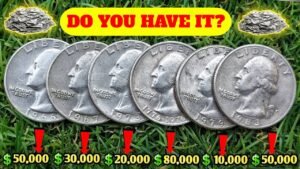
How Such Rarity Comes About?
It must be put clearly that not every 1976 Bicentennial Quarter is deemed precious. Millions of coins were made in that year, while the values in today’s market for certain specific variants or error coins seem astronomical.
Due to their being 90% silver and therefore minted specifically for collector sets, some of these coins have attributes of silver. Others have offered minting mistakes, which include double strikes, off-center strikes, die cracks, and metal mix errors. These coins are relatively rare and could bring millions at sale.
The $3 Million Variant
There arises a question — which 1976 Bicentennial Quarter is believed to value $3 million?

Collectors believe this is a coin which was erroneously minted at the Philadelphia Mint on a silver planchet, whereas normal quarters are made of copper-nickel. Thus, this error caused this coin to become a “Minting Anomaly.”
Less than a few such coins are known to exist, and one fetched as much as $3 million at auction. The coin is extraordinarily rare and historically, it is one of the greatest valued quarters ever to come out from the U.S. Mint.
Differentiating the Silver from Copper-Nickel Quarter
If you have a 1976 quarter on your hands, one of the first things you need to check is whether it is silver or copper-nickel.
- Silver shines and is lighter in color, while copper-nickel has a slight brownish tint on its edge.
- The silver version weighs about 5.75 grams, while the copper-nickel version weighs approximately 5.67 grams.
- If the mintmark “S” appears on the coin, it will likely belong to the silver one, as those marked “S” were minted in San Francisco.
Identifying The Error Coinage
Sometimes the real value of a 1976 Bicentennial Quarter is determined by the minting error. If any one of those coins happens to have any of the features below, it might be extremely scarce and could hold a big chunk of value:
- Double: The design is struck over to produce the pattern twice.
- Off-center strike: The coin is not struck precisely in the middle.
- Die Crack: There are cracks or lines slightly appearing on the coin.
- Metal Mix Error: The metal mixture is wrong, and the color looks strange.
Such coins can be up for auction from tens to hundreds of thousands to millions of dollars.
Have You Got Any Such Coin?
It’s possible that such a coin is lying in your collection of old currencies, for it may really be a 1976 Bicentennial Quarter.
Caution and in-depth scrutiny apply to your coins. Without fail, check old coins and the ones collected for such lucky finds of quarters labeled “1776–1976.”
Inquire how one does mint-mark or metal and error combinations, if any.
If it’s a silver or error coin, consider having it appraised by someone specializing in numismatics or coin appraisal services.
Where to Have it Appraised
There are many reputable grading agencies such as the PCGS (Professional Coin Grading Service) or NGC (Numismatic Guaranty Company), found both in the US and in Canada.
These agencies score coins according to their rarity and conduct evaluations scientifically and officially.
However, collectors and numismatic clubs in India can also do appraisals of such coins, although their credibility is limited.
If the coin happens to have decent worth, it can go to international auctions.
The Famous Amazing 1976 Bicentennial Quarters Auction
Over the years, various 1976 Bicentennial Quarters have sold for awe-inspiring prices at auctions.
- A particular MS68 grade silver quarter went for almost $13,500.
- A very rare Mint Error Coin went for over $216,000.
- The most valuable Bicentennial Quarter sold was one struck with an error on a silver basis, which grossed up to $3 million.
Will The Price Increase More Into The Future?
Yes, indeed. As these coins become rarer and their market availability dwindles, their values are bound to increase.
It enjoys enduring demand among collectors because it not only tells the story of America’s independence, but also symbolizes the economic and cultural glory of that era.
The Historical and Sentimental Value of the Bicentennial Quarter
This coin isn’t just a symbol of money — it’s also a symbol of America’s freedom, struggle, and unity.
The image of the “Drummer Boy” brings to life the courageous spirit of the youth of the American Revolution.
For every collector, this coin is not just a piece of metal, but a piece of history, encompassing the story from 1776 to 1976.
Conclusion
The 1976 Bicentennial Quarter is a coin that combines history, art, and wealth. Its uniqueness lies not just in its design or age, but in its rarity, which makes it one of the most valuable coins in the world.
If you own this coin, never underestimate it. It’s not just a quarter — it could potentially be a treasure worth $3 million.
Sometimes luck lies right in your pocket — all you need is a keen eye for it. So take a close look at your old coins, because you might just have the next rare Bicentennial Quarter.
FAQs
Q1. What makes the 1976 Bicentennial Quarter worth up to $3 million?
Rare minting errors, silver composition, and limited variants make certain 1976 quarters extremely valuable.
Q2. How can I identify if my 1976 quarter is silver or copper-nickel?
Silver quarters have a lighter color, no brown edge, and an “S” mintmark from San Francisco.
Q3. Where can I get my Bicentennial Quarter appraised?
You can get it evaluated by professional grading services like PCGS or NGC for accurate valuation.