
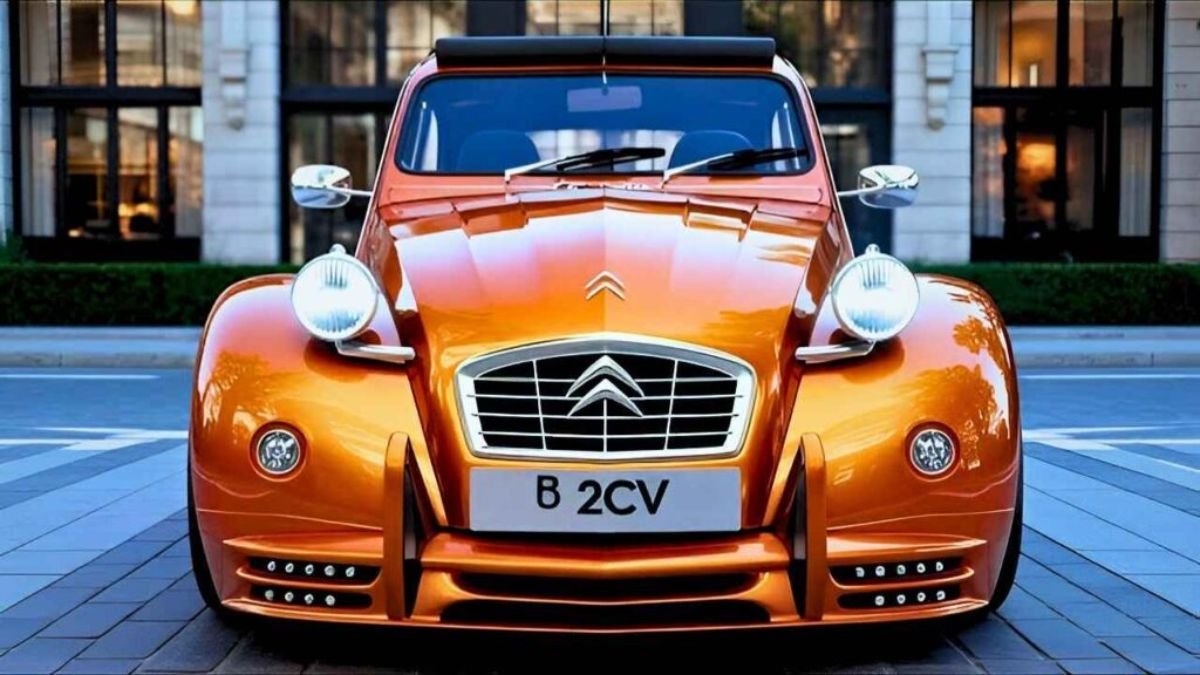
Introduction: If there are some vehicles in automotive history that have captured everyone’s attention through their unique thinking, unusual technology, and bold design, then the Citroën 2CV Sahara certainly comes to mind. It wasn’t just a “small car,” but an almost unique creation that also ventured into the realm of off-roading.
This article is prepared for Hindi readers – in it, we will understand everything about this car’s design, technology, mileage, price, and why it became “a truly overlooked marvel” – all in a user-friendly style.
The Beginning: The Original Idea of the 2CV
First, it’s important to know that the Citroën 2CV (whose name in French was “Deux Chevaux,” meaning “two horses”) was born as a concept a cheap, economical, simple but durable car that could be easily driven in rural areas and for everyday use.

Based on this 2CV, a very special version came out in the 1960s – the 2CV Sahara – which was specially designed for difficult terrains, desert and rural use.
Why “Sahara”?
The idea behind this name is also interesting – in French colonial territories, especially in North Africa (including the Sahara Desert), there was a need for vehicles that were lightweight, simple, but could handle extremely difficult roads. Citroën provided the answer in the form of the 2CV Sahara But its features weren’t limited to just the name – it was “something different” in terms of technology, design, and functionality.
Technical Marvel: Two Engines, Four Wheel
Here are the things that truly made it “shocking”:

- The 2CV Sahara had two air-cooled flat-twin engines – one in the front, one in the back. Each engine had a capacity of 425 cc.
- The reason for this was simple: the front engine powered the front wheels; The rear engine powered the rear wheels—thus, the vehicle behaved like a four-wheel drive (“4×4”).
- The gearbox was also unique—both engines were controlled by a single lever.
- There were also two fuel tanks—one for each engine.
What did this achieve?
This allowed the vehicle to operate in terrain where one engine alone would suffice, or where both engines together provided higher power. For example, the top speed with one engine running was approximately 65 km/h, while with both engines running it could reach approximately 105 km/h Although the engine power wasn’t very high—around 24 bhp in total—the lightweight body, simple construction, and four-wheel drive made it “unique.”
Design and Lightweight Construction
The exterior of the 2CV Sahara also tells its own story:
- A spare wheel was mounted on the bonnet (front).
- There were air vents for the rear engine, different wheel sizes, and equipment suitable for off-road use.
- The body was kept light to reduce weight and make driving easier in difficult terrain.
- The design was simple no flashy chrome but robust and functional.
- These design elements gave it the status of a “special utility” vehicle—not a leisure car, but a workhorse.
Fuel Efficiency and Usability
When we talk about fuel efficiency or commercial usability, there were some limitations and some positive aspects:

Positive Aspects: Due to the lightweight body, fuel consumption was relatively low—for example, it was advised that consumption could be around 9 liters/100km on normal roads.
Its ability to handle rough terrain made it special small engines, low power consumption, easy maintenance.
It was a good option for people in rural areas, farmers, or those working in remote locations.
Limitations: It didn’t have “high mileage” in the modern sense — especially in off-roading, fuel consumption increased significantly with both engines running.
Top speed was very low by today’s standards (only around ~100 km/h) — so it wasn’t designed for highway use or high speeds.
The technology was simple — therefore, there were fewer convenience features and less comfort.
Value and Collectibility
Both the original price of this car (at the time) and its current collector value are attractive:
- When it was released, its price was approximately double that of a standard 2CV.
- Production was very limited only about 694 units were made (from 1960-66).
- Today it has become a classic collector’s item some examples have fetched bids of €60,000-€100,000 at auction.
- The answer to “what is it worth?” depends primarily on its condition, rarity, and history.
Modern Relevance and Legacy
The significance of the 2CV Sahara in today’s world can be understood from the following points:
- It demonstrates how even a lightweight, simple car can become “unconventional” by adopting serious technology (such as two engines, 4×4 drive).
- It is still cited as an example in design philosophy — simplicity, utility, uniqueness.
- It is in demand in the collector world and has become a “special chapter” in automotive history.
- In contrast to today’s heavy SUVs and technologically advanced cars, it reminds us how experimentation, innovation, and courage can transform car manufacturing.
Conclusion
If you were to say that the Citroën 2CV Sahara was just a “small car,” you wouldn’t be wrong – but this car redefined the meaning of “small but mighty.” It demonstrates how, despite limited resources and a simple engine design, a vehicle can tackle the toughest terrains, go off-road, and challenge conventional engineering standards Today, as we navigate among modern cars with thousands of features, high-horsepower engines, and complex electronic systems, the 2CV Sahara reminds us that “small size” + “big idea” can equal extraordinary results.
FAQs
Q1. What is the Citroën 2CV Sahara?
A. The Citroën 2CV Sahara is a rare off-road version of the original 2CV, designed for rugged terrains with dual engines.
Q2. When was the Citroën 2CV Sahara produced?
A. It was produced between 1958 and 1966, with only around 700 units built.
Q3. Why is the 2CV Sahara considered special?
A. Its unique twin-engine setup, lightweight body, and off-road capability made it one of the most innovative compact cars ever built.